General coverage travel
guides for Greece
Greece: The Rough Guide
Mark Ellingham, Marc Dubin, Natania Jansz, John Fisher
Rough Guides, Ltd, London,
7th. ed., 1998; 12th ed, 2008; 13th ed, 2012
$25, 850 pages
ISBN 978-1-84836-727-2
A section on "Basics"
(getting there, police, health, sports, hours of business, festivals, finding work, etc.) is followed by
sections on each part of the country. These include info on accommodations,
places to eat and sites. Often, a city map is included. The site coverage goes beyond the normal to include a lot of "small gems."
After the country descriptions there is a section on "contexts" (historical framework, wildlife, mythology, music,
books, etc.) which also includes a brief phrase book.
Rough Guides used to aim at the
"brash" goal. That might put the student or scholar off, but
it shouldn't. The occasionally cheeky tone doesn't mean that the content
is flaky. It is oriented more for the backpacker and hiker than the upscale tourist,
focusing on cheaper hotels and which beaches you can sleep on. But for those non-backpackers who want to travel close to the land (that is, mix with Greeks) this is helpful. The sections
on "contexts" are well done: generally accurate and balanced.
Few guides, for example, bother to cover Greek music, this one does.
I'm not sure I like the direction they are going. The 13th edition is 200 pages shorter than the 11th, yet physically bigger. What has been cut out - just the sort of details you need.
Greece: Athens & the Peloponnese
Avalon Travel
2011
$20, 480 pages
ISBN 978-1-59880-772-1
It took Rick Steves a while to warm up to Greece; years back he was pretty dismissive and suggested you try Turkey instead. Turkey is worthy of your time, but fortunately, the guru of budget, politically aware, low-to-the-ground travel has decided Greece is worth your time after all.
Good general coverage of Athens, nearby islands and the Peloponnese. Good on getting around using local transport. For Athens has some nice city walks. Note that some of those are available as podcasts from iTunes.
Is near to the top of my list for a general guide.
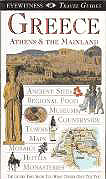
Greece: Athens & the Mainland
Eyewitness Travel Guides
DK Publishing,
first American edition, 1997
2003 edition: $24.95, 352 pages
ISBN 0-7894-1452-x
The tag line is "The Guides that show you what
others only tell you." For once, a tag line is accurate. This series,
like the Knopf guide to Athens, is a highly visual book, printed on slick
paper. Each page, almost, is in color, and takes advantage of it to include
pictures of locations, artifacts and so on. Much use is made of three-dimensional
reconstruction of ancient buildings.
The contents for the "Greece" volume include
sections as follows: Introduction (30 pages), Ancient Greece (15 pages
on history, the gods, etc.), Athens (70 pages), Mainland Greece (130 pages),
traveler's needs, and a survival guide. Note that the Greek Islands are
described in a separate book in this series.
The emphasis here is on the visual, coverage of hotels
and restaurants is minimal.
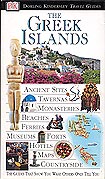
The Greek Islands
Eyewitness Travel Guides
DK Publishing
First American edition, 1997
2003 edition: $24.95, 398 pages
ISBN 0-7894-1453-8
Same as the above book, but coverage of the islands.
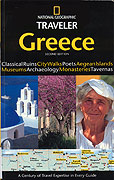
National Geographic Traveler: Greece
2nd edition, 2007
Mike Gerrard
$27.95
National Geographic was THE window to the world in my youth, a more image-impoverished, dignified (and arrogant) time. But still, one expects great images and literate text from this source. And we get some of that. This book focuses on brief site descriptions coupled with a striking image. More significant sites (e.g. Delphi, Epidavros) add an image or two, a map or a drawing. There is a very brief section at the back on travel practicalities, hotels, food and a page or two for a Greek phrase book.
I’m torn. I am genetically incapable of criticizing National Geographic, other than for not being like I remember it. Yet this book falls between several stools. It doesn’t have enough maps or hotel info to be taken on your trip to Greece, it doesn’t have enough (or large enough) photos to send you into spiritual orbit, and it doesn’t have enough historical data to be a companion on your armchair adventures (and you’d never sit and read this cover to cover). Yet – it certainly has some of all of those things. The photos are up to National Geographic standards. And what it has, it does pretty well
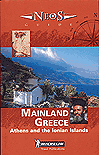
Begins with 50 pages on "Setting the Scene"
discussing history, flora, fauna, Greece today, art and architecture and
Greek mythology. Another 40 pages on "Meeting the People" discuss
daily life, social etiquette, religion, music, language and other topics.
Twenty more pages on travel practicalities precede coverage of the mainland
(Athens, Attica, Peloponnese, Thessaly, Epirus, Macedonia and Trace) as well as
close in islands (The Ionian Islands).
Each section has quick info on the essential things
not to miss as well as important pointers to remember.
The travel information is knowledgeable and aimed
at the serious traveler. Goodly number of photos and maps. The pocket size, and thin paper make this something you could consider taking with you on your trip.
It uses the Michelin system of rating sights with
one, two or three stars and provides cross references to the Michelin
maps especially to number 980.
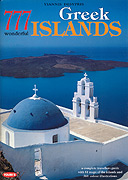
777 Greek Islands
Yiannis Diesypris
Michalis Toumbis, 1994
270 pages
There is a class of guides that is more popular or promotional in nature. These make no claim to objectivity, but try to urge upon you the amazing nature of the place. So, this guide calls one chain of islands, "priceless gems decorating this gulf with lavish beauty." In fact, on of the charms of Greece is that over the top rhetoric.
What this guide offers, in its larger format, are stunning photos of the islands in vivid, saturated colors. One seldom sees photos of the minor islands in other guides and most of the big guides make only very limited use of color at all.
Frommer's Greece from $45 a Day
John Levy, Kyle McCarthy, John Bozman
Macmillan Travel, 6th ed., 1995
$18, 650 pages
ISBN 0-02-860464-4
I suppose that the daily rate has
gone up quite a bit by now. So much of the travel magazines are devoted to outrageously
expensive lodgings - which they try to tell you are reasonable. I remember
an article years ago that described a place on Santorini as "moderate" at
$250 a day. Of course, the photos implied that the room came with a high
fashion model - but even so she looked too pouty to be much fun.
Frommer's looks at the reasonable end of things, not
the cheapest places but the low to middle.
This is where Greece can shine in accommodations. For not much more than
you'd pay for a normal chain hotel in the US you can have clean, comfortable
lodging within walking distance of the major sites. This guide also covers
eating places, but they come and go and there are so many of them, I've
never thought this was of much use.
| Last modified 6/30/19; posted 3/13/2000; original content © 2019, 2000 John P. Nordin |


