Some pointers for those planning to use the ferry system
for a Greek trip.
|
||
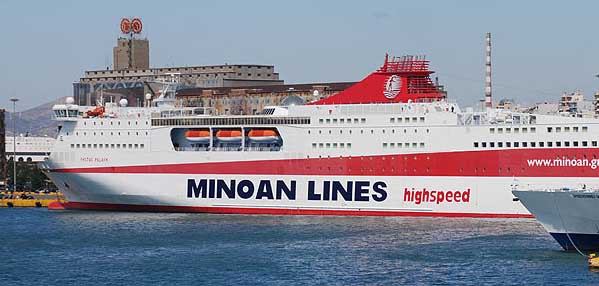
While the informality and casual or missing signs tend to drive some nuts, the ferries are a pretty reliable way to get around. They run when scheduled, arrive on time, and go where they said they would, most of the time. I'd encourage those of you with a little spunk to go ahead and use them. It can be relaxing and you see a slice of Greek life. Ticketing has been computerized, putting an end both to ferries leaving oversold, or with empty seats but no way to purchase them. Don't expect to get your ticket as you board. Go to the ferry company's office (usually near the harbor) and get your ticket a day or two in advance. At most harbors, you'll see places within easy reach to change money, get a taxi, and usually a few hotels. And in most cases, the harbor is right in the center of the main town of the island. However, there are exceptions, like Santorini, where the ferry landing is not at the heart of anything. In those cases, busses often run from the ferry landing into the main square. Within a harbor there are typically several ferry landing areas. The major ferry may leave from one spot, the hydrofoils from another and local boats from a third. You need to be aware of which boat comes where. Ferries from Athens leave from both Pieraus and Rafina. Rafina is to the east of Athens across Attica. Pieraus is the port of Athens. To get to Pieraus you can take bus or the subway from central Athens. To get to Rafina is a one hour bus ride. The bus leaves from a spot to the north of central Athens. A city bus connects with the bus to Rafina. Within Pieraus there are several different locations for ferries. Also note that some ferries leave from Zea marina which is some blocks to the east of the Pieraus port area. You've noticed the distinction between ordinary ferries and hydrofoils. Hydrofoils are twice as fast and priced about twice as much. See my essay on the hydrofoils. What about safety? Accidents do happen, but are not so common as to make ferries a risk. Now and then, some ferry runs against the rocks or collides and people die. I'm certainly not minimizing this, but certain precautions are in place. Boats do not sail during bad weather thus removing the biggest potential problem. You are seldom out of sight of land - thus rescue from local fisherfolk and emergency services are close to hand. And the water is warm, unlike northern Europe so people do survive. But do not expect a well-organized response on the boat if it starts to sink. It is prudent to note exits and think things through. Again, the accident rate is not high. For any and all ferry trip planning, there is just one book you're going to need to get. That is the Thomas Cook Guide to Greek Island Hopping Follow the link for my review of that book. |
| Last modified 2/17/12; posted 8/8/00; original content © 2012, 2000 John P. Nordin |