| The Plaka > Locations > Kalavryta > |
|
 |
||
| Back |
Hundreds of men and boys are murdered.
|
Next |
|
||
|
December 13th, 1943: In the morning the bells rang out, and the message was circulated that the Nazis had ordered everyone to take a day's worth of food and a blanket and gather at the school. People speculated that they were being evacuated - thus the need for food. Others thought the town would be burned as a reprisal for the execution of the captives. |
|
|
As the villagers gathered at the school they were divided. The men and boys over 12 went into one group, the women and children under 12 into another. |
|
|
"That was a heartbreaking separation. The men kissed their children, took a last glance at them, choked back the tears and walked on. The separation was an eternal one." The solders searched the town for people who were hiding. They came upon a husband attending his wife as she gave birth, unassisted by doctors or medicines. The solders seized the man leaving the woman to morn the loss of one amid the miracle of the birth of another. |
|
|
The men were taken to a field above the town, a natural bowl with a view of the village. They were ordered to sit. The men waited. |
|
|
The Germans began to burn the town while the men watched. One Greek approached a German officer and asked what would happen to them. Would they be killed? "No, nothing like that will ever happen. You have my word as an officer. We will destroy the city, because the partisans are coming. We are going to relocate the population." When this was translated, "an audible sigh of relief came from the crowd. The word of an officer meant something to these men." At 10:30 the sound of the train was heard, departing from Kalavryta with the loot the Germans had taken from buildings before setting them afire. |
Hours passed while the town was consumed by fire. The men watched helplessly
as sacred places of childhood memory, the safe refuge of hearth and home,
their life's work was consumed.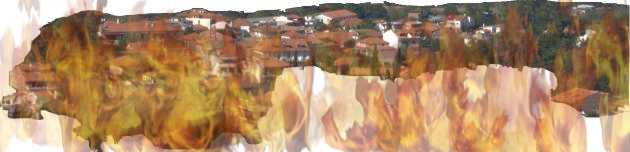 |
|
Some officers arrived and conferred with those already present. A flare was seen from a distant hill. After a second flare, an order was shouted, and then machine guns, previously hidden from the men, began to fire upon them. The men fell on one another, shouting and calling out. A few buried under the bodies of those less fortunate were only wounded. Stilling the machine guns, the Germans went around and shot those who were still moving. Still, a few survived. The German soldiers marched off, singing. Earlier, the women had been confined in the school house. As the town began to burn around them, the women had only some small windows to see what was happening. Some hid their head in their hands as the braver ones called out the owner's names as each house begun to burn. The school began to fill with smoke. Eventually, the women were released by a guard who could not stand his orders any longer, and they flowed out into the smoke and rubble of the town. Another guard diverted the women away from the place of execution. At four that afternoon, the Germans having withdrawn, the women found
the bodies of their husbands and sons. Sifting through the tangled and
bloody pile of hundreds of disfigured corpses, women searched for their
loved ones. "Isn't that my husband? And that my son? No, my son wasn't wearing a jacket and he had blond hair. That must be Giannia's son. Then came the ravens and the foxes and the dogs. They smelled the blood. So the women couldn't leave the bodies. They spent the night near the stiffened corpses. Anyway, where could they go? There were few houses not burned to the ground. There was no food." |
| The cold winter night falls, but it is not silent. The women are wailing, babies bewildered and hungry, the dogs howling. Home and family gone, it is less than two weeks to Christmas. |
|
Last modified 7/12/00;
© 2000 John P. Nordin
|
Sources | How many died? | Next |